

Healing Across Generations
Dear Women Who Came Before Me And Those Still Surviving,
I’m writing this with care. What lives here now is not anger, but understanding, empathy, context, grief, and a deep awareness that I am healing something that did not start with me.
I can recognize that many of you needed someone too, and that you were doing the best you could while carrying pain that was never named, supported, or given space to heal.
So how do we become what others need when we ourselves were raised without stability, safety, or consistent care?
Many of us became mothers wanting to do better, to give our children a safer, softer, more secure life than the one we had.
We wanted to break cycles and give our children a better chance. And yet, when life remains unhealed, even the best intentions don’t protect us from making mistakes. Loving deeply doesn’t always mean we show up regulated. Wanting better doesn’t erase the impact of unresolved trauma.
We often say we will give what we didn’t receive, but when life is lived in survival mode, love doesn’t always arrive whole.
Sometimes it comes in pieces, present one moment, absent the next.
That kind of inconsistency doesn’t fade with time; it shapes the nervous system, attachment, and how safety is experienced in the body.
Disorganized Attachment
Some of us are walking around with disorganized attachment and don’t even have language for it. Disorganized attachment forms when the people meant to provide safety are also unpredictable, unavailable, or unsafe, when love and fear exist in the same place. The body learns early to want closeness and stay alert at the same time. Many adults don’t know this is what they’re carrying; they just know closeness feels confusing.
How could regulation be learned when survival was the priority? How could trust feel natural when comfort was inconsistent? One moment love was there, the next it wasn’t, so the body adapted by learning not to get too comfortable. This isn’t a flaw; it’s a nervous system shaped by experience.
What Children Need
Children, across every generation, need the same things. They don’t need adult conversations placed on their shoulders, secrets, gossip, or emotional responsibility. They don’t need to manage the pain of the adults raising them. They need consistency. They need reassurance. They need to know they are loved, safe, and worthy without having to earn it.
Many women were raising children while they themselves had never been given the chance to simply be children. Some grew up without fathers. Some were raised by mothers stretched thin, caring for many children with little support. Some carried the burden of being the oldest, the helper, the one others leaned on, while quietly drowning themselves. Some had their innocence taken by someone they should have been able to trust. Some struggled with addiction while yearning for recovery. Some wanted to heal but lived in constant chaos, where stability never lasted long enough to rest in.
How do you heal when life never slows down enough to feel safe? How do you learn your worth when no one ever reflected it back to you?
Trauma and Bravery
Unhealed trauma rarely stays contained. It shows up in relationships, repeated disappointment, and attachment patterns that were never chosen, only learned. And still, there was effort. There was resilience. There was bravery. The courage to speak what had long been unspoken. The strength to get back up again and again, even when the odds were never fair. Even when life is cut short, that bravery matters.
Grief Across Generations
And the grief doesn’t belong to just one person. A mother loses a daughter. Sisters lose a sibling. Children lose someone they love. Grief becomes part of the family system too.
Do you know how hard it is to parent while grieving? Grief that was never acknowledged. Grief with no space to process. Grief that lived quietly while life demanded you keep going. Some of you put your kids first and never dealt with your grief.
Some of you were drowning in grief, and your kids didn’t always get the best version of you. Both can be true.
Protection and Survival
Now we have cousins, sisters, and daughters living with one shared goal: escape what was, not because they are judgmental, but because they are protecting themselves from a pain they already felt or a pain they watched you carry.
Avoidance becomes protection. Distance becomes regulation. Walls become a form of safety. It’s easier to put a wall up when you’re scared. It’s easier to leave than to risk repeating history.

Secrets and Healing
They say you’re only as sick as your secrets. Secrets kept out of shame, guilt, loyalty, or the belief that protecting others mattered more than telling the truth, they don’t disappear. They live in bodies. They show up in relationships. They get passed down through attachment, silence, and survival.
This letter isn’t written to blame anyone. It’s written to name what shaped us, and to say that healing doesn’t mean pretending it didn’t hurt.
I am allowed to hold compassion for what you didn’t have and clarity about what was needed. I am allowed to hold both. Maybe that’s how cycles begin to break, not through silence, not through denial, but through truth, education, accountability, and care.
Choosing Healing
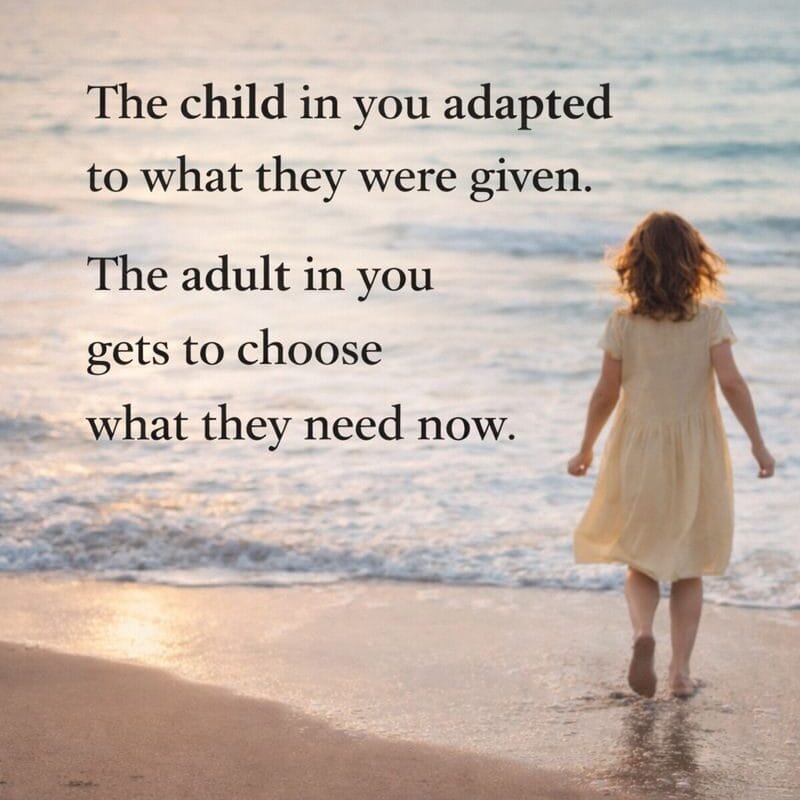
I have learned, and am still learning, that the most powerful thing we can do for the people we love is to put our mental health first. Not last. Not after everyone else. Because unhealed pain doesn’t stay private, and regulated adults create safer children. Choosing healing is not selfish; it is preventative, protective, and deeply loving.
I have learned, and am still learning, that safety can exist without chaos. That love doesn’t have to disappear. That survival doesn’t have to be the only way to live.
And maybe that is the beginning, for me, for you, or for whoever comes next.
This piece is a personal reflection intended for education and awareness, not a substitute for therapy or clinical treatment.
Welcome to the Nest! 🌿 This is a space for growth, creativity, and supportive dialogue. To keep this community safe and helpful for everyone:
- Be Kind: Treat others with the same empathy you’d bring to a clinical space.
- Privacy Matters: Please don’t share specific identifying information.
- Constructive Only: Disagreement is fine; disrespect is not.
- Note: To prevent spam, all comments are held for manual approval by yours truly.
Leave a Comment