

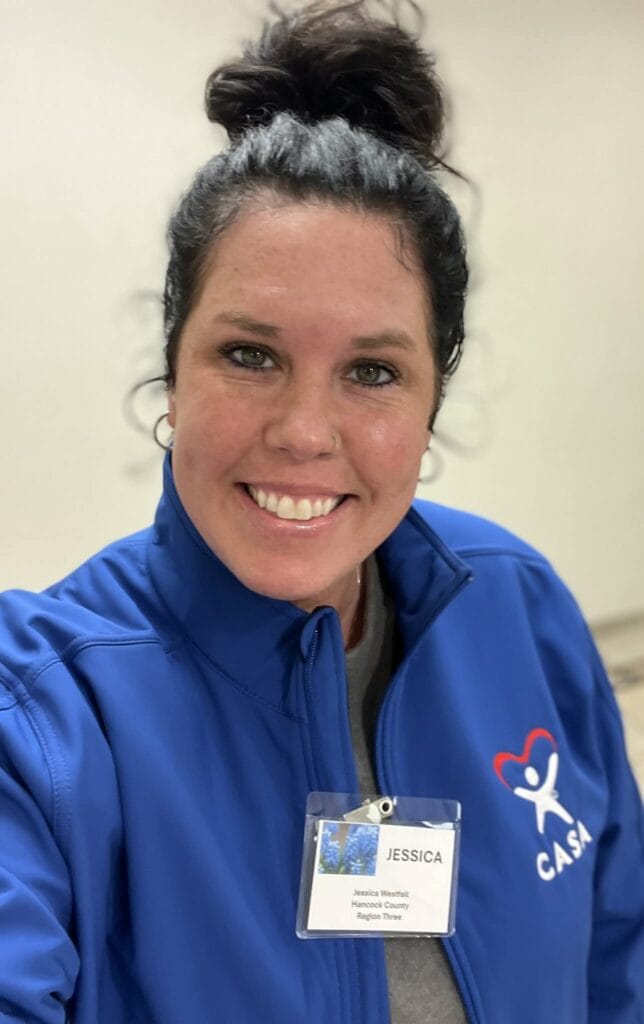
A Calling That Started with a Facebook Scroll
Jessica knew she wanted to turn her pain into purpose, she just didn’t know what form that purpose would take.
She was working at the Wellness Center in McCordsville, sitting on her lunch break, mindlessly scrolling Facebook, when a post for CASA volunteers stopped her mid-scroll.
“It just hit me,” she told me. “This is my chance. This is my moment. This is what I need to do.” It was her “aha” moment.
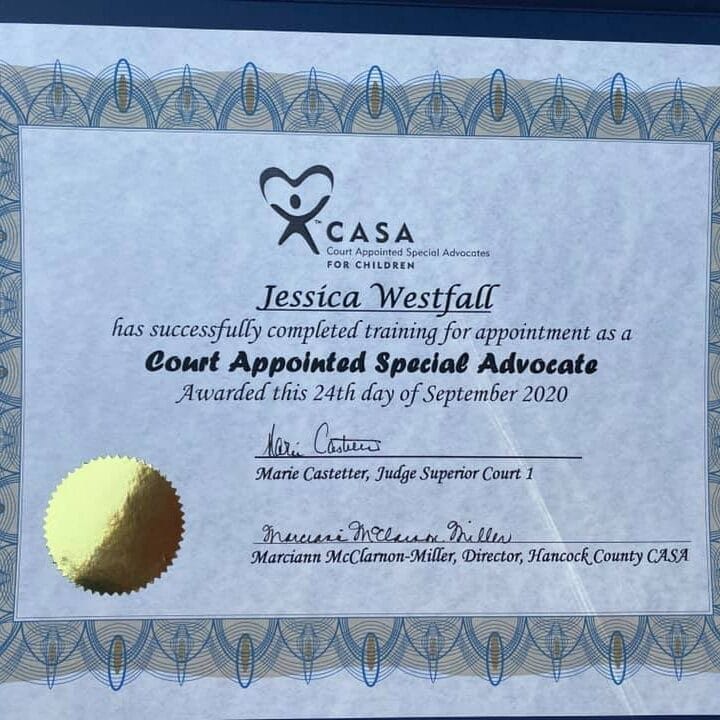
She applied immediately. By September of 2020, she became a CASA volunteer and she took three cases right away.
That was the beginning.
Volunteer → Administrative Assistant → Director by 2024.
But the titles are not what define her.
What stands out is that she still carries a case outside of work hours. Not because she has to but because staying close to the heart of the work keeps her grounded.
“This is my purpose, this is who I’m supposed to be.”
A Team That Feels Like Family
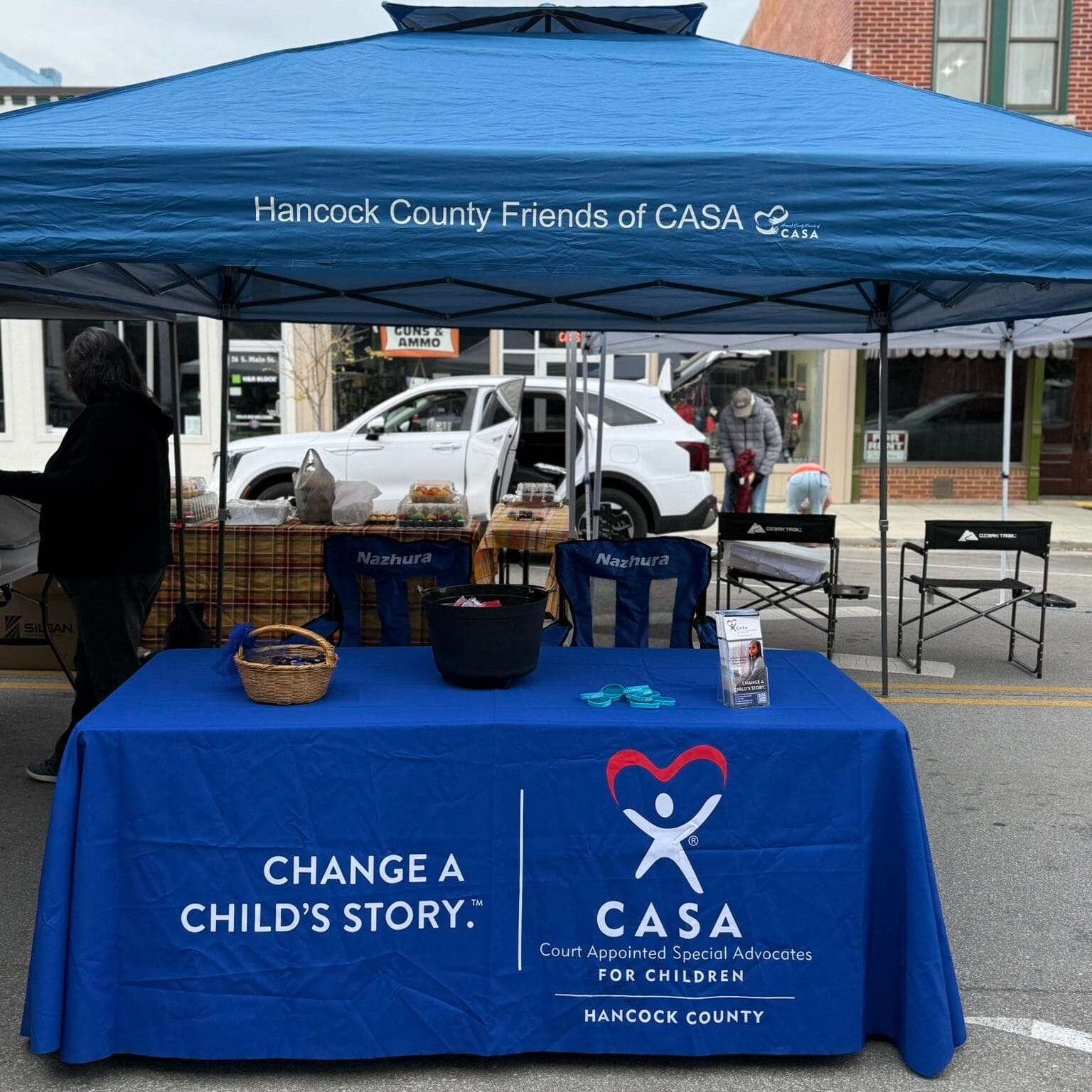
Hancock County CASA has 5 staff members and around 50 volunteers now. I knew CASA was volunteer-led, but I never realized how many volunteers it takes to make it all work. Their goal is 60, 60 volunteers speaking up for children who need a consistent voice. Jessica shares their team covers for one another, cross-trains, steps in when a volunteer can’t make a visit, and stays available at all hours because children’s lives don’t only happen from 9 to 5.
When Jessica talks about her team, she lights up. “We’re very close and very supportive of each other. We do a lot of venting,” she shared.
In social services, confidentiality shapes everything. Unlike many jobs, you can’t go home and unload your day at the dinner table. You can’t tell your spouse. You can’t share details with your friends. Your team becomes the only group of people who truly understand what you witnessed, what you held, what you carried home with you. “You need people who get it,” she said. And she’s right. As we talked, we both agreed on something I’ve said many times: unless you’ve worked in child welfare, you will never fully understand it. It’s a world unlike anything else, it has its own rhythm, its own heaviness, its own kind of heartbreak and hope.
One of the first things Jessica said that made me smile was: “We celebrate all of the little wins.” Not because the big ones don’t matter, but because the little ones often mean the most:
~A child who makes it through the day without an incident.
~A teen who stays in school for an entire week.
~A parent who shows up to a service they’ve been struggling with.
Small things from the outside could be huge things on the inside.
CASA is strength-based not in theory but in practice. They point out what is working, what is growing, and what is possible, the voice in the room saying, “Look, something good is happening too.”
“We celebrate all of the little wins.”
The Work: Heartbreak, Hope, and What Kids Remember Most
And those little wins matter even more when the work is heavy. Jessica didn’t gloss over the hard parts. “We go into the homes, which is the most private area families have,” she shared. And seeing people struggle is really challenging, because most of the time, they actually want to do better.
She doesn’t view families through labels. She sees them as humans, flawed, hurting, trying. “We never want a parent to feel attacked or judged,” she said. “If an update isn’t positive, it’s not about opinions. It’s just about the reality. We’re just trying to keep the children safe.” Her voice wasn’t defensive, just honest. Then, she said something that I think every volunteer needs to hear: Parents are usually their own worst critics. Parents don’t need anyone to remind them of their failures. They need someone who sees the good still present in them, even if it’s buried. Jessica’s compassion is quiet, strong, and deeply rooted.
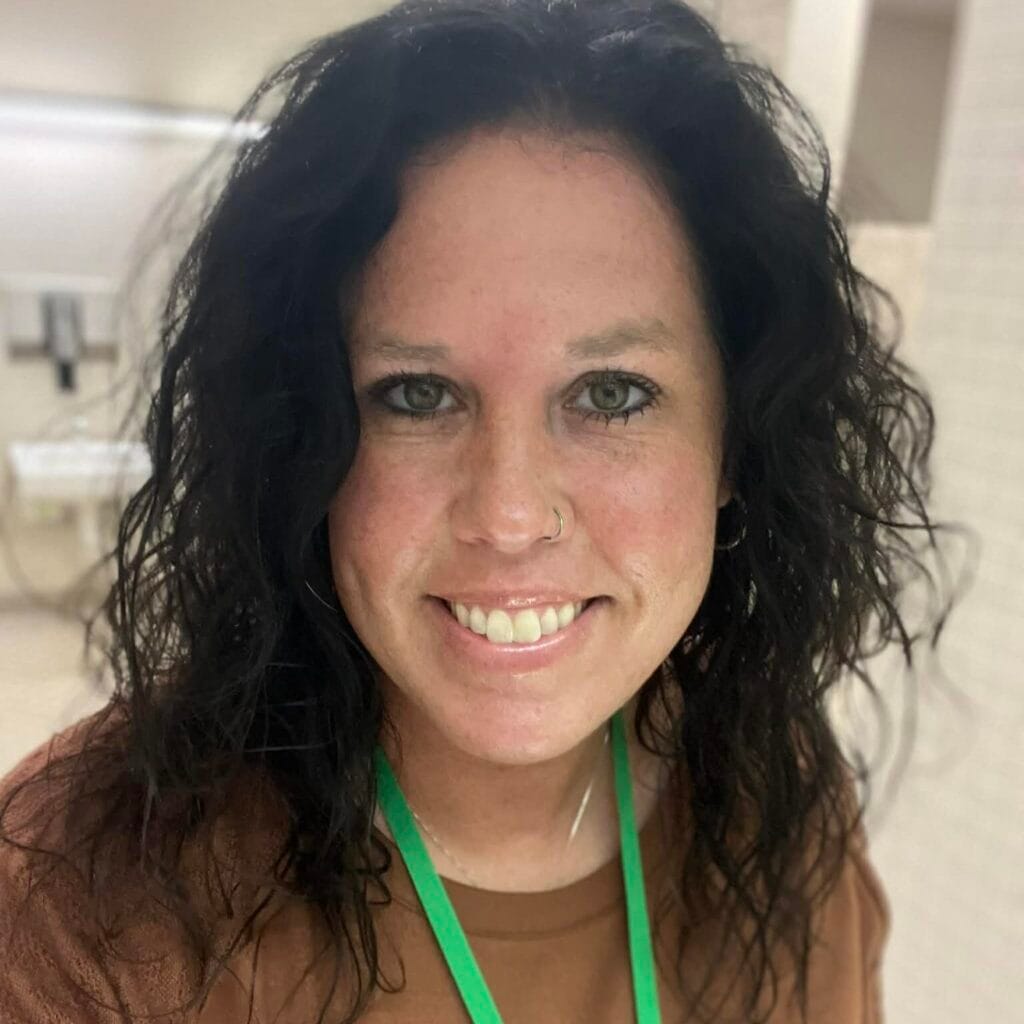
As she talked about the difficult parts of walking into families’ hardest moments, she also shared something deeply personal: the source of her passion. When I asked Jessica how she learned to show up with such passion, she told me about her own childhood trauma and later adulthood trauma. For years she carried shame around those chapters, but therapy helped her begin to see them differently.
She doesn’t tell kids she knows exactly what they’re going through. But she understands enough to meet them where they are. She returned to a phrase she had said earlier, a message she hopes every child carries with them: “Your story doesn’t define who you are,” she said. “You aren’t the things that have happened to you.” And then she said it again: “I’ve always wanted to give my pain a purpose.” Jessica shares her experiences help her hold space for someone else’s. And that, more than anything, feels like the heart of her calling.
Consistency: The Thing Kids Remember Most
When a child is in the system, turnover becomes part of their world: Providers change. DCS workers change. Placements move. Therapists rotate. Schools shift. But CASA stays.
“They can be moved four hours away, to the top of the state, to the bottom of the state, anywhere and we stay with them,” she said. “Sometimes the kids are shocked. Like, you’re still showing up?”
That kind of consistency rewires something. Kids begin to expect people to leave. CASA proves not everyone does. She told me how some children open up less with every new provider because they’re tired of retelling their trauma. Some start believing it’s their fault when workers disappear. CASA becomes the one thread that doesn’t break. Volunteers stay for years sometimes nearly a decade.
Casa becomes a quiet, steady presence in lives shaped by uncertainty.
“Your story doesn’t define who you are,” she said. “You aren’t the things that have happened to you.”
Leadership Shaped by Learning
The woman who held the director role before Jessica shaped her deeply. Jessica talked about her with such genuine admiration, her leadership, her steadiness, the way she cared for volunteers, the pride she took in the program she built. Jessica stepped into leadership with the weight of those shoes in mind. “It’s honestly such a privilege,” she said.
And you can tell she means it.
That foundation shaped how Jessica leads today curious, collaborative, and always learning.
Something I noticed about Jessica immediately is how much she values understanding the entire system not just CASA’s corner of it. She asks questions constantly. She attends trainings. She brings in partners from probation, community corrections, law enforcement, the sheriff’s department anyone whose expertise can help her volunteers understand the bigger picture. Because judgment comes easy when you don’t understand how a system works. But once you learn the guidelines, the limitations, the why behind decisions, it changes everything.
Volunteers need ongoing CEUs every year, and she works hard to give them meaningful, relevant opportunities. She believes lived experience is “top tier” learning the kind of insight you can’t get from textbooks or policies. Jessica shared at a gala last year, they invited the author of Three Little Words to speak a woman who grew up in foster care and used her story to create change.
Experiences like that stay with volunteers long after the training ends. And honestly, I think Jessica’s hunger to understand the full system is one of the reasons she rose into leadership so naturally.
Staying Grounded in a Heavy World
But even with all the tools, training, and leadership experience, the work still carries weight and Jessica is honest about what it takes to stay grounded. Jessica is open about her struggle with boundaries. “I’m really bad at turning things off,” she said with a tired laugh many of us know too well. She goes to therapy weekly, works hard not to bring cases home emotionally, leans on her team, and stays intentional with her kids. She’s a firm believer that therapy shouldn’t carry stigma. “It doesn’t make you crazy,” she said. “It’s okay to need help.” If anything, helpers deserve support just as much as the families they serve.
Advocacy and the Bigger Picture
Jessica serves as chair of the Community Corrections Board and is a member of the Sexual Assault Response Team (SART). Both roles strengthen her understanding of how every part of the system intersects. She talked about CASA Day at the Statehouse, advocating for changes that give children more rights, educating legislators, and supporting State CASA as they push for legislation that protects families.
When it comes to leadership, she tries to embody what she admired in others: “You get out of your employees what you put into them. I’ll never ask someone to do something I wouldn’t be willing to do.”
She wants to be approachable, honest, human, and a leader people trust. And she admitted something that made me smile, she wishes she had started CASA sooner. She reflected on how, years ago, CASA volunteers were often retired adults. But now she’s seeing a shift: more full-time working younger adults stepping up. Purpose is finding people earlier.
Jessica is the first to say she hasn’t learned this work alone. She talked about how the former Chief of Probation played a significant role in helping her understand the broader system. His guidance, context, and support gave her a clearer view of how different agencies connect and what effective collaboration looks like.

She also relies on the State CASA Director as a resource, someone she can call with questions and who helps her see how statewide decisions shape local practice. Those relationships matter, she said, because they remind her she doesn’t have to know everything, just stay curious and keep asking questions.
“You get out of your employees what you put into them.”
“I’ll never ask someone to do something I wouldn’t be willing to do.”
What She Wants People to Know, About CASA, About the Work, and About Themselves
As we wrapped up our conversation, I asked Jessica what she hopes people understand about CASA and about stepping into this kind of work.
Her answer was honest and simple. “You can’t be in it for the money,” she said with a soft laugh. “You have to focus on the wins. Let them carry you. Let them remind you why you’re here.”
And then she shifted into what matters most: CASA is not here to judge. Not here to shame. Not here to decide who is worthy. Not here to take sides. CASA is here to advocate, with compassion for parents, respect for a family’s humanity, and a commitment to truth over assumptions. “We try to be factual,” she said. “We’re never forming opinions about their worth. We just want to keep the kids safe.” And that, truly, is the heart of CASA.
Learn more about Hancock County CASA or how to volunteer: https://www.casahancockcountyin.org/
For those who want to understand more deeply, she shared a few resources: books and lived-experience stories she believes help people see the system more clearly:
Book: Many Lives of Mama Love
A beautifully honest memoir that shows how a woman walked through addiction and incarceration, slowly piecing her life back together in a way that reminds you redemption is real.
Book: Three Little Words: A Memoir
Ashley’s story takes you inside her years in foster care in a way that’s raw, hopeful, and impossible to forget, showing how one child’s resilience can change the entire trajectory of her life.
Closing Reflection
Welcome to the Nest! 🌿 This is a space for growth, creativity, and supportive dialogue. To keep this community safe and helpful for everyone:
- Be Kind: Treat others with the same empathy you’d bring to a clinical space.
- Privacy Matters: Please don’t share specific identifying details.
- Constructive Only: Disagreement is fine; disrespect is not.
- Note: To prevent spam, all comments are held for manual approval by yours truly.
Leave a Comment